



You don’t need to be rich, a math genius, or glued to the stock market to start investing. As a high schooler, you have something no adult investor can buy, time. When it comes to building wealth, time is your biggest advantage. Here’s something you should know, if you’re curious:
Time in the Market Is More Important Than Timing the Market
This principle has been emphasized by many experts including Warren Buffett. For example, if an investor missed just the 10 best trading days between 2000 and 2019, their overall returns would have been cut by about 50%. Because the best days often occur unexpectedly, trying to pick the perfect time to enter the market is nearly impossible.
How to actually open an account
There are a few different routes you can take to gain access to investing:
- Have a parent open a custodial account for you
- Open a Fidelity Youth account
- Open a standard brokerage account if 18+
- Use a parent’s preexisting account (not recommended)
- Use a funded platform like TopStep if 18+ and actively trading (highly not recommended)
Keep in mind that there are other account types, like Education Savings for college expenses and a Roth IRA for tax-free contributions if you have a job.
Traditional custodial accounts
In the U.S., a custodial account must be opened by the parent, and be in the minor’s name. In Connecticut, when the child turns 21, the account is moved to a standard brokerage account. Note that while the child is a minor, the account is still technically operated under the parent, and it is up to them to provide you the ability to trade on it.
There are two types of custodial accounts. A UGMA (Uniform Gifts to Minors Act) account allows financial assets only: cash, stocks/bonds, mutual funds, CDs and insurance policies. This type of account is less complex to open, and does not require provisionments for physical assets. A UTMA (Uniform Transfers to Minors Act) account, on the other hand, allows real estate, jewelry, art, and physical assets in addition to the UGMA’s allowances.
The best brokers for traditional custodial accounts include Charles Schwab, Fidelity, and Vanguard. Choosing a consumer bank like Chase or Wells Fargo might not provide access to research tools, certain order types, asset classes, extended hours, or fractional shares.
Fidelity Youth Account
This is a unique account offered to teens 13-17, where the teen is the owner and decision maker from the start. It allows the ability to invest in most U.S. stocks and ETFs. Parents simply approve the account opening and have access to monitor activity, but teens control all trading decisions. It converts to a regular brokerage account at age 18.
Why should I even open an account?
The first $1,350 of unearned income in a custodial or youth account is tax-free, so even if you don’t plan on investing at all, tell your parents they can save some money by opening an account. Past the initial $1,350, unearned income up to $2,700 is taxed at the child’s tax rate, which is practically always lower than an employed parent’s tax rate.
What do I invest in?
Historically, many of the actively managed funds on Wall Street underperform the broader market. Rather than trying to beat the market through active stock picking, a strategy that even professional fund managers fail at consistently, invest passively in a low-cost, market-matching ETF using dollar-cost averaging. Common choices include: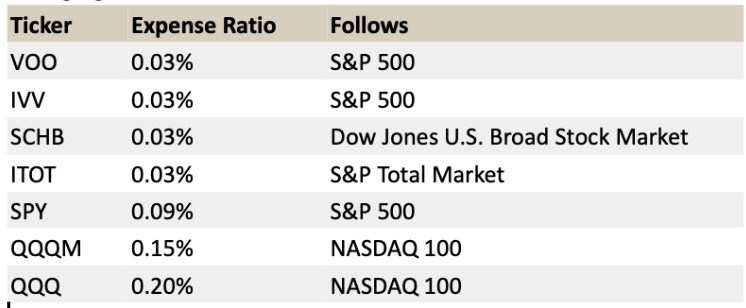
If you still really want to try out active investing
- Start by paper trading on platforms like TradingView, Interactive Brokers, or ThinkOrSwim
- Start with companies you are highly familiar with
- Use research tools like Yahoo Finance, Barrons, Bloomberg, and Unusual Whales.
- If you have a Charles Schwab account, Schwab Research is highly valuable
Consider these metrics before buying a stock:
- Valuation (am I paying too much for a stock?):
-
- P/E – compare to competitors
- P/B – useful for banks, asset-heavy companies
- P/S – helpful if a company isn’t profitable yet
- PEG – factors in future growth
- Profitability:
-
- Profit Margin: % of revenue that becomes earnings
- For long term quality (Will this company grow?):
-
- Growth: revenue + earnings increasing
- Cash Flow: positive free cash flow = sustainable operations
- Return (like ROE/ROIC): management uses money wisely
- Beware of “trading gurus;” many of them make more money from selling courses than trading and often do not publish their official brokerage account records.